
Data retention policy: A practical guide to compliance, security, and control


Every business keeps data. Some records need to remain available for tax, contractual, security, or regulatory purposes. Some data supports day-to-day work. Some data loses its value quickly and becomes clutter, a cost, and a risk, like old database backups, stale logs, or unused cloud storage buckets that no one is actively reviewing or managing. A data retention policy exists to address that.
In this guide, we’ll look at what a data retention policy is, why it matters, how retention schedules work, and how to build a policy that stands up to legal, security, and practical scrutiny.
Please note: This article is intended for general informational and educational purposes only. It should not be read as legal advice.
What is a data retention policy?
A data retention policy is a set of internal rules that explains how long an organization keeps different kinds of data, how that data is stored, and when it must be securely deleted or otherwise rendered inaccessible.
It helps organizations meet legal and regulatory requirements, including those that may apply depending on where they operate and what kind of data they handle. For example, the General Data Protection Regulation (GDPR) applies across the EU and European Economic Area (EEA) and, in some cases, to organizations outside those regions, while the Health Insurance Portability and Accountability Act (HIPAA) applies to covered entities and business associates in the U.S. healthcare sector. It also helps reduce storage costs and lower security risk by avoiding the retention of data that is no longer needed.
A data retention policy applies to both physical records and digital information, including structured data in databases and business systems, as well as unstructured data such as emails, documents, chat logs, and file shares. In plain terms, data retention means keeping information for a defined purpose and period, then removing it in a controlled way when that purpose ends.
A strong policy connects retention to the full data lifecycle. It extends beyond storage. It covers classification, access, review, legal hold, backups and replicated copies, disposal, and evidence of deletion or destruction. That’s why many organizations use the terms data retention policy, document retention policy, and data retention and destruction policy in closely related ways. The names vary, but the core idea stays the same.
Key terminology to know
Before getting into the policy itself, it helps to define a few terms that frequently appear in data retention, governance, and compliance discussions.
| Term | Description |
| Audit trail | A record of who accessed a system and what actions they took, used to trace activity and support accountability. In retention workflows, it helps ensure deletions are controlled and traceable. |
| Data lifecycle | The path data follows from collection through use, storage, review, and disposal. |
| Data retention | Keeping data for a defined period for a legal, regulatory, operational, or security reason. |
| Legal hold | A temporary pause on deletion when litigation, investigation, or audit risk means records must be preserved. |
| Retention schedule | A category-by-category timetable that says how long each record type stays and what triggers deletion, archive, or destruction. |
Why data retention policies are important
A retention policy answers a basic governance problem: businesses collect data faster than they sort it. Over time, that can lead to inconsistent storage, duplicate files, stale personal data, bloated backups, and unclear deletion practices. Good data retention policies bring structure to that chaos in the following ways.
Meeting compliance standards
Many laws don’t set a single company-wide retention period. Instead, they set principles or minimum periods for certain records. The GDPR, for example, reflects the storage limitation principle in Article 5(1)(e), which requires personal data to be kept in a form that permits identification for no longer than necessary for processing. If data is truly anonymized so that re-identification is not reasonably possible, it no longer counts as personal data under the GDPR. Pseudonymized data, however, still does, so it remains subject to retention limits.
The California Consumer Privacy Act (CCPA), as amended by the California Privacy Rights Act (CPRA), requires businesses to disclose the retention period for each category of personal information, or the criteria used to determine it. It also states that personal information shouldn’t be kept longer than is reasonably necessary for the disclosed purpose.
The HIPAA Security Rule requires certain policies, procedures, and related documentation to be retained for six years from the date of creation or the date last in effect, whichever is later.
Strengthening data security
Data that no longer needs to exist can still be stolen, leaked, or mishandled. Old customer exports, forgotten test databases, stale access logs, and abandoned employee folders are common weak points. The retention part of your policy is a security control in that sense. It narrows the volume of information that must be protected and reduces the harm a breach can cause.
This matters even more in regulated environments. The Payment Card Industry Data Security Standard (PCI DSS) ties retention to minimizing the amount of data stored and properly disposing of it. That said, disposal should be treated as a controlled process that makes data inaccessible at the required level, not just deleted from the live system.
For example, data may still persist in backups, logs, replicated environments, caches, or, in some cases, on storage media even after a file is deleted. Depending on the system and the sensitivity of the data, proper disposal may require measures such as cryptographic erasure, secure wiping, or physical media destruction.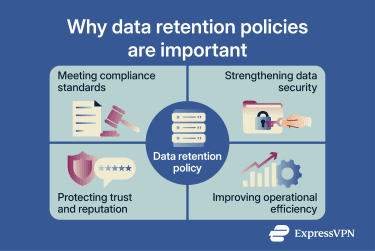
Improving operational efficiency
Retention isn’t only concerned with law and security. It helps teams work faster. Search results improve when outdated files aren’t mixed with current ones, and storage costs stay closer to reality. Migration, backup, and restoration work also become less messy. Legal review and eDiscovery become less expensive when the business isn’t carrying years of unnecessary duplicate material.
Protecting trust and reputation
People notice when companies collect more than they need, keep it too long, or can’t explain what happens to it. A clear retention model supports transparency in data privacy. Under the GDPR, data subjects must be told the period for which personal data will be stored, or the criteria used to determine that period. Under the CPRA, businesses must disclose retention periods or criteria for each category of personal information.
That kind of clarity supports trust. It shows the business has thought about data protection as a management issue, not just a checkbox.
How long should data be retained?
There’s no universal answer. Retention periods depend on the type of data, the purpose for collecting it, the laws that apply, the contracts in place, and the risks associated with retaining or deleting it.
Legal and regulatory requirements
Start with the legal requirements that apply to each record category.
| Framework/ authority |
What it requires | Retention period |
| GDPR | Personal data shouldn’t be kept longer than necessary. Organizations should set time limits for erasure or periodic review. | No fixed period for most categories. Uses a principle-based standard. |
| Information Commissioner’s Office (ICO) guidance | Reinforces the storage limitation principle and notes that data protection law usually doesn’t set exact retention periods. | No set time limits in most cases. |
| CPRA | Businesses must disclose the retention period for personal information or the criteria used to determine it. Personal information cannot be kept longer than reasonably necessary for the disclosed purpose. | No universal fixed period. Must be tied to the disclosed purpose. |
| HIPAA | Certain documentation under the Security Rule must be retained. | Six years from the creation date or the date last in effect, whichever is later. |
| PCI DSS v4.0.1 | Stored cardholder data must be kept to a minimum and retained only as long as necessary for legal, regulatory, or business needs. Sensitive authentication data must not be stored after authorization, except in very limited cases defined by PCI DSS. | No fixed period for cardholder data. Retain only as long as necessary, then securely delete. Sensitive authentication data must not be retained after authorization, except where PCI DSS expressly allows it. |
| Securities and Exchange Commission (SEC) Rule 17a-4 | Broker-dealers must preserve certain records, including duties tied to electronic recordkeeping and audit trails. | Some records must be kept for at least 6 years, while others must be kept for at least 3 years. |
Business and operational needs
Law is only part of the answer. A business may need to keep data to support contracts, chargebacks, fraud checks, customer support history, warranty claims, tax support, internal investigations, or core reporting. But those needs don’t justify open-ended retention. The retention period should match a real business purpose, not a rough guess.
This is where many teams get the sequence wrong. They choose a retention period first and try to justify it afterward. For example, a company might decide to keep security logs for one year because that feels like a standard period, only later trying to connect that choice to incident response, audit, or compliance needs. The better approach is to start with the purpose, then assess how long the data remains genuinely useful for that purpose.
Risk and liability considerations
Keeping data too long creates its own risk. Old information can be inaccurate, out of context, or legally sensitive. In modern systems, stale data can also affect analytics, automation, or machine learning outputs by feeding decisions with information that is no longer accurate, relevant, or representative.
It can widen breach exposure, expand the scope of discovery, and increase the cost of responding to subject access requests, investigations, or litigation. That’s why the GDPR ties storage limitations to periodic review. If the original purpose has ended, retention needs a fresh legal or business basis.
But deleting too early also carries risk. A business that cannot produce required tax, employment, health, finance, or audit records may face penalties, failed audits, a weak litigation posture, or a broken operational history. A retention policy is meant to balance those two types of requirements.
How retention schedules work
A retention schedule turns a policy into action. It lists record categories and assigns a rule to each. At a minimum, it should identify the:
- Data or record category.
- System, location, or service where the data is held, including on-premises systems, cloud regions, Software-as-a-Service (SaaS) tools, and relevant third-party processors.
- Business owner, legal or operational basis for keeping it, and retention period.
- Trigger date or event, such as contract end, account closure, employee departure, last user activity, or last login, and, where possible, the system timestamp, status field, or other value that can be used to automatically enforce the trigger.
- Final action, such as archive, delete, shred, or sanitize.
A simple data retention policy example might look like this:
- Customer contracts: Keep for 7 years after expiration, then archive or delete based on the legal hold status.
- Job applicant records: Keep for the recruitment period plus the applicable employment-law retention period.
- Security logs and audit trails: Keep for the period required by internal security, incident response, and applicable sector rules, then rotate or destroy.
- Payment card data: Don’t retain unless a specific legal, regulatory, or documented business need applies. If retention is justified, keep only the minimum necessary for the shortest appropriate period, protect stored primary account numbers (PANs) by rendering them unreadable where required, and, when retention ends, securely delete or destroy the data using an appropriate method, such as cryptographic erasure or media destruction.
Consequences of non-compliance
Poor retention practices can lead to multiple types of failure.
- Privacy regulators may view over-retention as a breach of storage limitation or transparency duties.
- Sector regulators may treat missing records as a recordkeeping failure.
- Security teams may inherit more stale data than they can manage safely, expanding the attack surface and increasing both breach impact and the number of places an attacker can move across after compromise.
- Litigation costs rise when old material still exists but is poorly indexed.
- Infringements can lead to administrative fines, investigations, settlements, and civil money penalties.
How to create a data retention policy
A policy works only when it aligns with how the business actually handles information. That means the drafting process must start with systems and workflows, not with template wording.
Identify the data you collect
Begin with data mapping. Look at customer data, employee data, marketing data, finance records, support tickets, vendor records, logs, backups, email, chat, and shared drive content. Include shadow systems, too, such as exports on individual laptops, unmanaged spreadsheets, SaaS exports, local downloads, personal cloud storage such as Google Drive, and data residing in third-party tools.
Classify data by type and sensitivity
Next, group the data. Typical categories include personal data, sensitive personal data, financial data, health data, legal records, contracts, tax records, security logs, and operational content. Classification helps separate low-risk material from data that carries a heavier data privacy, security, or regulatory burden.
This is where electronic records need special attention. Unstructured data often creates retention risk because it can contain sensitive or regulated information outside formal systems. For example, a spreadsheet full of customer details may look informal, but its retention and deletion responsibilities may be just as serious as those of a formal database.
Define retention periods
Once categories are clear, assign periods based on legal requirements, operational need, and risk. Keep the reasoning documented. For a GDPR data retention policy, this part is very important. You may need to explain not only how long data is kept but also why that period is necessary and how the business reviews it over time.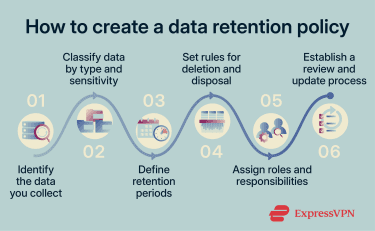
Set rules for deletion and disposal
Deletion rules need to be specific. Say what happens at the end of the retention period. Is the data deleted from the live system, archived, anonymized, shredded, or sanitized using a defined method? What happens in backups, snapshots, and replicated environments? If deletion is delayed there, when does it occur: through backup rotation, snapshot expiry, or another scheduled process? What happens when a legal hold applies? Who approves exceptions?
For physical media and high-risk digital assets, disposal should follow a recognized sanitization approach such as the National Institute of Standards and Technology (NIST) Special Publication 800-88 Rev. 2. In that context, sanitization means rendering access to the target data infeasible for a given level of effort. It should be a controlled process tied to data sensitivity and the type of media involved.
Assign roles and responsibilities
Someone has to own the policy. In practice, ownership is usually shared. Legal interprets retention obligations. Compliance tests policy coverage. IT and security handle system controls, deletion workflows, and audit evidence.
In GDPR contexts, the data protection officer (DPO), if required or appointed, may advise on retention periods, privacy risks, and data subject rights. Business owners define operational use cases. Records or privacy teams often coordinate the whole process.
Without clear roles, retention slips into a gray area where everyone assumes someone else is handling it.
Establish a review and update process
Policies age quickly. New products, new systems, new markets, new vendors, and new laws can all change the right answer. Review the policy on a fixed cadence and after major legal or operational changes. Keep version history. Update the retention schedule when a category changes, not months later.
Data retention policy best practices
Data retention best practices are readable, usable, and tied to systems that can enforce them.
Document retention rules clearly
Write the rules in plain language. Avoid policy text that sounds polished but leaves room for guesswork. If the policy says data is kept “as needed,” define what that means for each category. If deletion depends on an event, name the event. If an exception process exists, show who approves it.
Transparency matters outside the policy, too. Privacy notices and internal guidance should line up with the retention schedule. GDPR and CPRA both expect businesses to tell people how long information is kept or how that period is determined.
Align legal, compliance, and IT teams
Retention breaks down when teams work in isolation. Legal may set a defensible period that IT cannot enforce. IT may automate deletion that conflicts with a legal hold. Compliance may audit the written rule but miss data stored in a legacy SaaS tool.
The policy should be drafted and maintained as a shared control.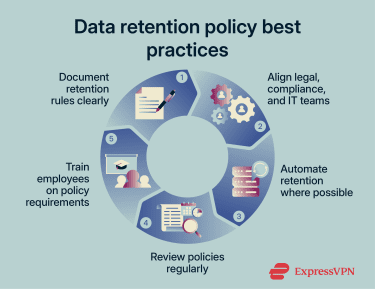
Automate retention where possible
Manual deletion doesn’t scale well. Automation helps apply retention schedules consistently across email, document repositories, backups, logs, and cloud systems, using enforcement mechanisms such as storage lifecycle policies, data loss prevention (DLP) rules, and security information and event management (SIEM) or log retention configurations.
Review policies regularly
A policy that never changes is a warning sign. Laws move. Product lines move. Data spread grows. The retention rule that works for one customer relationship management system, one human resources platform, and one region may no longer work after a merger or platform change. Build review into the policy itself.
Train employees on policy requirements
Training matters most at the point of creation and deletion. Employees need to know what belongs in approved systems, what shouldn’t be copied into side files, how legal holds work, and why deletion rules aren’t optional. Many retention failures start with ordinary habits such as saving local copies, exporting reports “just in case,” forwarding data to personal email accounts, or keeping old folders after a project ends.
The challenges of data retention
Even good policies run into friction once they meet real systems and real behavior.
Managing multiple regulatory requirements
Retention obligations often overlap without neatly matching. Privacy law may push toward minimization. Finance, tax, or employment law may require a minimum period. Then, sector standards may demand logging, auditability, or record preservation. The answer isn’t one master period. It’s a careful categorization.
Balancing access, storage, and security
Data must remain usable during the retention period. That means controlling access, storage location, backup coverage, encryption, encryption key management, and deletion timing without making the record impossible to retrieve when it’s legitimately needed.
In some environments, key lifecycle decisions also affect deletion, since data may become effectively inaccessible through measures such as crypto-shredding, where encryption keys are securely destroyed.
Handling legacy and redundant data
Legacy systems are one of the biggest retention problems. They often hold duplicate customer data, lack clear ownership, have poor metadata, and lack effective deletion tools, API support, or built-in retention controls. They may also contain fragmented data across structured and unstructured formats, with limited indexing or searchability, which makes it harder to identify what should be retained, reviewed, or deleted.
Adding data spread across multiple databases, cloud apps, archives, employee devices, and shared drives makes enforcement of retention much harder. A policy may look clean on paper but still fail in practice if the systems it covers are out of scope.
FAQ: Common questions about data retention policies
How do you decide how long to keep data?
Who should own and enforce a retention policy?
How often should a data retention policy be reviewed?
What is the difference between data retention and data deletion?
Do small businesses need a data retention policy?
Explore the web with greater privacy
Get ExpressVPNSign up today for a chance to win FIFA World Cup 2026™ tickets.