Expressvpn Glossary
Web3

What is Web3?
Web3 is often described as the next stage of the internet, envisioned to move away from centralized control by governments and Big Tech. It uses blockchain and decentralized networks to run applications, store data, and verify transactions without a single authority in charge.
This approach aims to create a more open, secure, and censorship-resistant online environment where users manage their own digital identities and assets.
How does Web3 work?
As opposed to Web2 (the current version of the web, which relies on centralized servers owned by companies like Google, Facebook, or Amazon), Web3 runs on decentralized networks. Independent operators manage “nodes,” which store data, verify transactions, and keep applications running. Blockchain technology links these nodes, while smart contracts automate actions without intermediaries.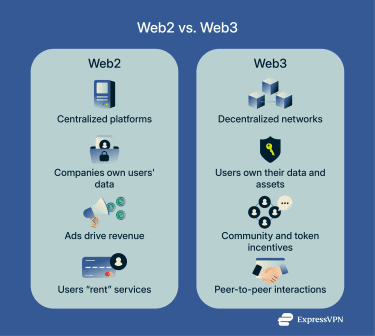 Users access Web3 through decentralized applications (DApps) and use digital wallets to manage assets and confirm identity. They can trade digital tokens and non-fungible tokens (NFTs), participate in decentralized finance (DeFi) platforms, and vote in decentralized autonomous organizations (DAOs). Without central control, participants interact directly, maintain ownership of their data, and access services from anywhere with an internet connection.
Why is it important?
Web3 gives people control and ownership of their data. It offers a decentralized and transparent framework that builds trust and supports autonomy online. It breaks centralized power structures that have shaped the internet.
Blockchain records transactions in a tamper-proof way and cuts the need for intermediaries in secure digital exchanges.
Creators reach their audiences directly, keep control of their work, and take part in a more inclusive digital economy where everyone can participate in decision-making.
Where is it used?
Web3 finds practical use in a variety of industries, each applying decentralization and blockchain to address specific needs. From financial services to creative platforms, these applications show how the technology is moving beyond theory into everyday use.
- Finance: Web3 introduces cryptocurrencies and DeFi that compete with traditional banking models.
- Healthcare: Some projects explore using Web3 to keep medical records secure and transparent, though adoption is still limited.
- Governance: Decision-making models can become more inclusive with decentralized systems, though their efficiency is still being tested.
- Content creation: Creators can distribute work directly to audiences and maintain control over their creations.
- NFT galleries and the metaverse: While NFT art galleries are one of the most visible applications, NFTs more broadly serve as decentralized certificates of ownership. In metaverse environments, they can represent not only digital artworks but also virtual real estate, in-game assets, and more.
- Other industries: Web3 is also applied in supply chain, insurance, real estate, gaming, and social media.
Further reading
- What is Web3, and why does it matter?
- Web2 vs. Web3: What are the key differences?
- Why the world must demand a decentralized internet
FAQ
Is Web3 the same as blockchain?
No. Web3 is the decentralized web, and it uses technologies like blockchain and cryptocurrency to coordinate its network of nodes.
Can I use Web3 without cryptocurrency?
Yes. While cryptocurrency is often associated with Web3, the two are not inseparable. Web3 can exist without being tethered to crypto, and its broader vision includes technologies like decentralized identity, storage solutions, and governance models.
What are some examples of Web3 applications?
Examples include decentralized finance (DeFi) platforms, non-fungible token (NFT) marketplaces, and metaverse environments where people can interact and own digital assets. These applications run on decentralized networks instead of servers owned by one company.