Expressvpn Glossary
Software-defined networking (SDN)
What is software-defined networking?
Software-defined networking (SDN) is a network architecture that separates the control plane (decision-making) from the data plane (traffic forwarding). Instead of individual routers or switches independently determining end-to-end behavior, an SDN controller can define policy and program forwarding behavior through software interfaces.
Key components of software-defined networking
SDN is built around a small set of components that separate network control from traffic forwarding.
- SDN controller: A software system that hosts network control logic. It maintains a global view of the network and determines how traffic should be handled across devices.
- Southbound APIs: Switches and routers operate in the data plane and are responsible for forwarding packets. They generally follow the rules provided by the controller (and, in some deployments, may still run certain control functions locally).
- Northbound APIs: Allow applications and management tools to communicate with the controller. They are used to define network policies and desired behavior at a higher level.
- Network virtualization layer: This layer abstracts the physical network into logical or virtual networks. It enables segmentation, scalability, and centralized management independent of underlying hardware.
- Applications and automation tools: These are software applications that interact with the controller using northbound APIs. They implement policy, orchestration, and automated network control functions.
How does software-defined networking work?
SDN operates by centralizing network control and applying policies across the network from a logically centralized point. Applications define the desired network behavior, which the controller translates into traffic-handling rules and distributes across network devices. Changes to network behavior are implemented by updating software policies, allowing traffic flows and network segmentation to be adjusted without reconfiguring physical hardware.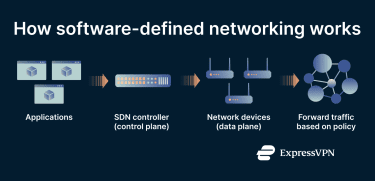
Benefits of software-defined networking
SDN provides centralized and simplified network management, enabling control from a logically centralized point. It can improve scalability and help optimize traffic handling through software-based policies. SDN allows faster deployment of new services by reducing manual configuration.
Centralized visibility can enhance monitoring and troubleshooting across the entire network. Programmable policies can strengthen security through more consistent enforcement. Additionally, SDN reduces dependence on specific hardware by abstracting control from physical devices.
How software-defined networking enhances network security
SDN can improve security by centrally enforcing network segmentation and automatically applying policies across devices. It can enable dynamic segmentation adjustments based on network conditions, reducing the configuration errors common in distributed management. Centralized policy enforcement helps ensure consistency, though the controller’s critical role requires robust protection to prevent it from becoming a single point of failure.
Common use cases of software-defined networking
SDN is often used in environments where networks need to scale, adapt, and be centrally controlled without constant hardware changes.
- Cloud data centers: SDN is commonly applied to data center virtualization and modern data center architectures, helping support cloud service deployment and operations at that layer.
- Large enterprise networks: Enterprises use SDN to manage complex networks spanning campuses, data centers, and wide area networks (WANs). Centralized control helps keep policies consistent across locations and network domains.
- Zero-trust network architectures: Some designs use software-defined perimeter (SDP) approaches at the network layer, often incorporating concepts from SDN.
- Multi-tenant network environments: SDN architectures can expose virtual network details to applications while keeping tenants separated. That separation includes isolating one customer’s service from another’s.
- Network automation and orchestration: SDN relies on APIs/interfaces that enable software to dynamically change network behavior. Network services and business applications can interface with SDN controllers for better integration and coordination.
- Internet of Things (IoT) device management: SDN-style access fabrics can be used to manage and secure IoT devices alongside user network access, including in some zero-trust workplace deployments.
Further reading
- SD-WAN vs. VPN: Which is the right choice for your business?
- Network architecture: Building secure and modern networks
- A complete guide to MPLS VPN services for secure and reliable connectivity