Expressvpn Glossary
Public IP

What is a public IP address?
A public Internet Protocol (IP) address is the unique number assigned to a device or network that connects it to the internet. It acts as a global identifier for a network’s connection point to the internet, enabling accurate routing of data to and from that network’s devices.
Public IPs are contrasted with private IP addresses, which never appear on the public internet.
How does a public IP work?
An internet service provider (ISP) assigns a unique public IP address to the router, allowing connected devices to access the internet. When a device goes online, its data passes through the router, which uses the public IP to send the request through the ISP to the wider internet and return the response to the correct device.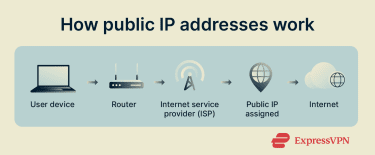
There are two types of public IP addresses:
- Static: The IP address is assigned permanently to a device or network. These connections are more stable and fit for hosting websites.
- Dynamic: The IP address changes whenever the provider’s Dynamic Host Configuration Protocol (DHCP) server reassigns it. These connections change over time, which offers some privacy benefits.
Public IP addresses are managed by the Internet Assigned Numbers Authority (IANA) and distributed through five Regional Internet Registries (RIRs). Each address is assigned to a specific region or service provider, ensuring global uniqueness and preventing overlap.
Because these assignments are region-based, a public IP can also indicate the general geographic location of the network using it. Websites and online services use this information a public IP provides to deliver location-specific content, apply regional settings, manage access, and monitor geographic activity.
At the same time, this visibility can affect privacy. Since a public IP can reveal location and activity patterns, it can be used to track or profile users across online services. To limit IP sharing, devices need to use privacy-enhancing tools like virtual private networks (VPNs).
Why is a public IP important?
A public IP address allows devices and networks to communicate over the global internet. It provides the foundation for online connectivity: public IPs are central to how websites, applications, and services function and interact.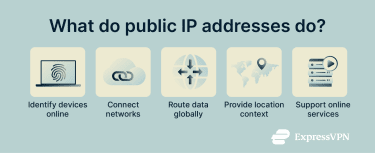 Public IPs are important because they:
- Enable access to the internet: Without a public IP, activities such as browsing, streaming, or using cloud services online aren’t possible.
- Direct responses to your network: Each public IP ensures that information sent over the internet returns to the right network or device.
- Support geolocation: Public IPs can reveal the general region of a connection, allowing websites and services to tailor content, apply regional settings, or analyze traffic patterns.
- Maintain network visibility: They provide a unique identifier that helps manage, monitor, and secure internet-connected systems.
Where are public IPs used?
Public IP addresses are used wherever direct communication with the internet is needed.
- Home and business: They use public IPs to connect to the internet. Homes typically use dynamic addresses, while businesses lease static ones for consistent access and hosting.
- Hosting: Websites, cloud platforms, and online applications rely on public IPs to send and receive data globally. Fixed addresses ensure that these services remain accessible from anywhere.
- Gaming and Voice over Internet Protocol (VoIP): Stable public IPs help maintain smooth, real-time connections for online games, video calls, and voice communication, reducing lag and interruptions.
- Remote access: VPN and remote desktop services rely on a public IP address to locate and connect to a network over the internet from outside its local environment.
Further reading
FAQ
What’s the difference between public and private IPs?
A public IP address is a globally unique identifier assigned by an internet service provider (ISP) and visible on the internet. A private IP address is assigned within a local network and used only for communication between devices inside that network.
Can I hide my public IP address?
Yes. Privacy tools such as VPNs or the Tor browser can hide a public IP address by routing traffic through encrypted servers that assign a temporary, alternate address.
Is a static public IP better than a dynamic one?
They have different use cases. Static addresses never change and are fit for hosting or remote access. Dynamic addresses are assigned automatically and change at regular intervals; this helps prevent your activity from being correlated.
Does ExpressVPN mask my public IP?
Yes, ExpressVPN masks every user’s public IP address by routing traffic through its own secure servers. This process replaces the original IP with one from the VPN’s network, limiting online tracking and exposure.