Expressvpn Glossary
Network congestion
What is network congestion?
Network congestion occurs when demand for a network’s resources exceeds its total capacity. Too many devices simultaneously accessing the network can cause high latency, slow speeds, unstable connections, and other performance issues. It's most common during peak usage and can affect both routers (processing nodes) and links (transmission paths).
How does network congestion occur?
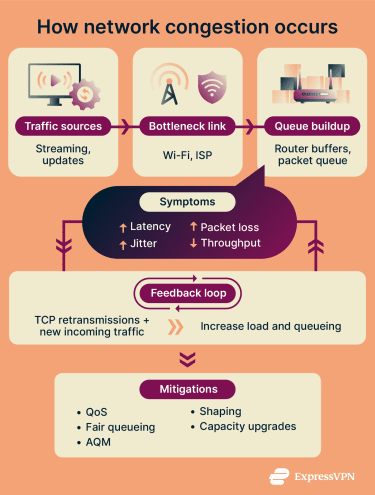 When traffic spikes beyond network capacity, router buffers fill. As a result, packets may be queued in router buffers rather than forwarded immediately. Those queues then build up, increasing latency and jitter, with packets arriving at their destinations at different times.
Some packet loss also occurs as buffers overflow, with retransmissions increasing the load and congestion. Even as protocols like Transmission Control Protocol (TCP) reduce send rates to ease the load, users still experience long load times, delays, and app performance issues.
Where does network congestion occur?
Network congestion can occur at many points in a network, including:
- Home Wi-Fi and shared broadband networks.
- Public Wi-Fi networks (e.g., hotels and campuses).
- Mobile networks, including hotspots.
- Enterprise wide area networks (WANs).
- Cloud edges, content delivery networks (CDNs), and data centers.
The effects of network congestion
Network congestion degrades network performance and can disrupt how applications and infrastructure operate. Common effects include slower connections and service instability, but beyond inconveniencing users, network congestion can have other effects:
- Denial-of-service (DoS) similarities: Symptoms can resemble DoS attacks, which may complicate detection or slow incident response.
- Overwhelmed defenses: Resource-heavy security tools may underperform when the network is overloaded.
- Traffic prioritization: Providers may classify traffic and apply rate limits or prioritization policies to certain types of applications (such as streaming or gaming).
Further reading
- Why is my internet so slow? Wi-Fi speed issues and solutions
- Throughput vs. bandwidth: Key differences and why they matter
- What is network jitter, and how does it impact internet performance?
- How to fix packet loss for a stable connection
- How to test your internet speed: A secure and simple guide