Expressvpn Glossary
DNS hosting
What is DNS hosting?
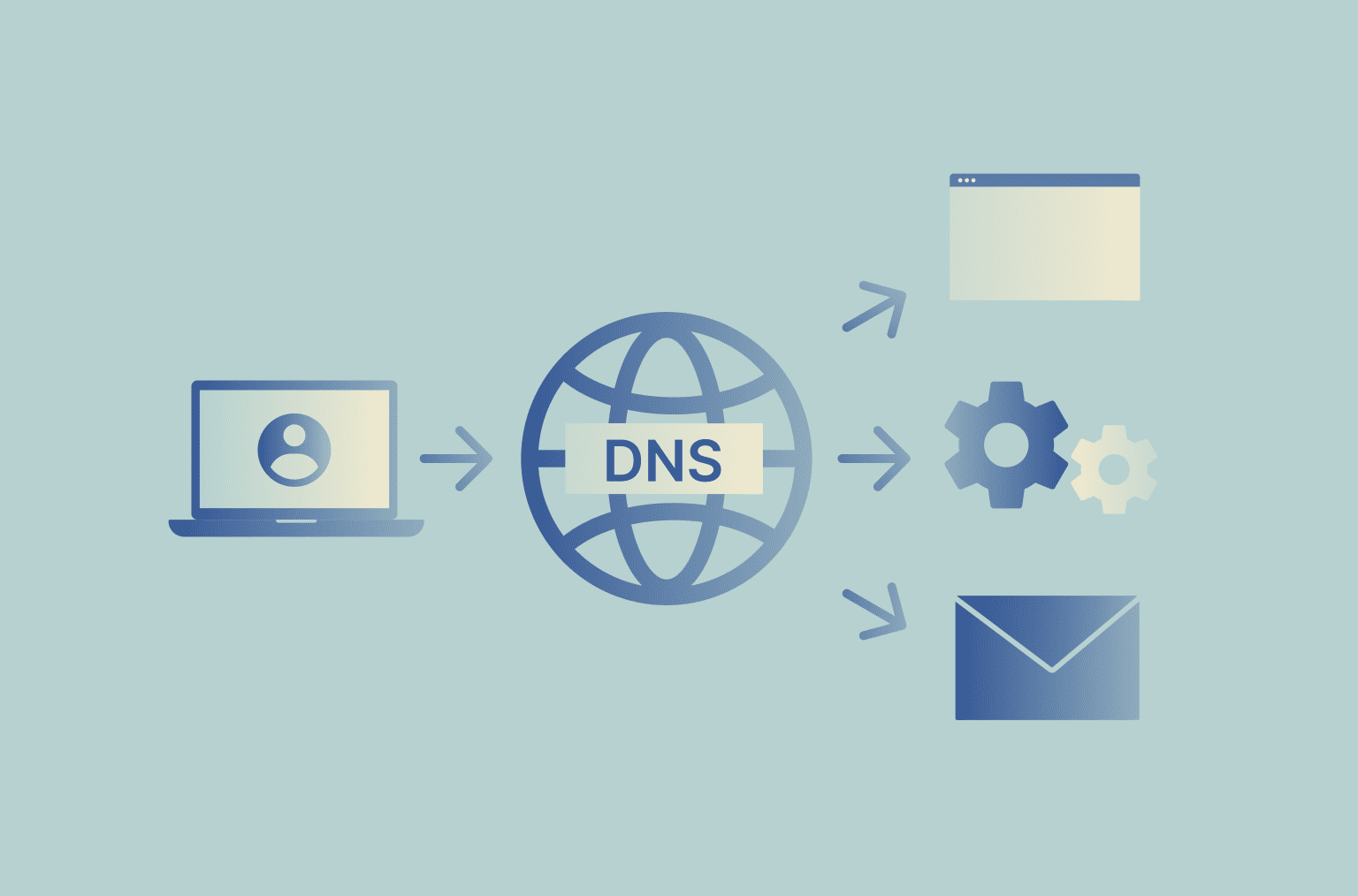
Domain Name System (DNS) hosting is a service that stores and serves a domain’s DNS records on authoritative DNS servers. These servers publish the domain’s DNS zone data, including records that direct traffic to the correct online services, such as websites, email, and other internet resources.
How does DNS hosting work?
After a domain is registered, the owner points the domain’s nameservers to the chosen DNS hosting provider. The provider stores the domain’s authoritative zone data and answers queries from recursive resolvers, returning the requested DNS records, such as IP addresses or other configured record types. DNS Security Extensions (DNSSEC) adds cryptographic signatures to DNS data, allowing DNSSEC-validating resolvers to verify its authenticity and integrity.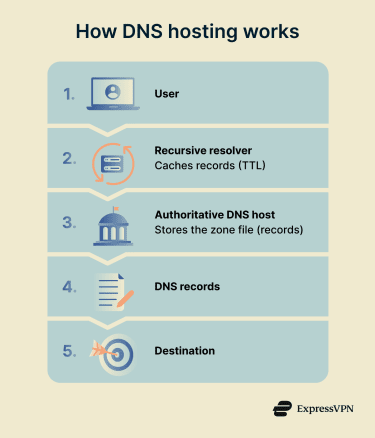
Types of DNS hosting
Several common types of DNS hosting include:
- Registrar‑provided: Basic authoritative DNS often included with domain registration.
- Managed providers: Third-party authoritative DNS, often operated on distributed networks for reliability, ease of management, and performance.
- Cloud‑integrated: Authoritative DNS integrated with cloud platforms and related services (for example, load balancing).
- Self‑hosted: Authoritative DNS operated on infrastructure managed by the organization.
- Split‑horizon: A DNS configuration or deployment pattern that provides separate internal and external DNS views that return different answers depending on the requester’s network.
Why is DNS hosting important?
DNS hosting is important because DNS records map domain names to the correct services, helping websites and applications remain reachable. It also supports performance: geographically distributed authoritative nameservers can reduce lookup latency, while resolver caching can reduce repeated lookup time. For email, DNS records such as mail exchange (MX) and text (TXT) enable mail routing and authentication, which can improve deliverability.
Reliable DNS hosting adds resilience through redundant authoritative infrastructure, helping services remain available during outages and enabling failover. It also strengthens security, since DNSSEC can help protect against DNS response spoofing and tampering by allowing validating resolvers to verify DNS data authenticity and integrity.
Where is DNS hosting used?
DNS hosting is used to support websites, applications, and APIs. It's also used to route email via MX records and to support email authentication via TXT records, such as the Sender Policy Framework (SPF). Many organizations use DNS hosting to direct traffic for content delivery and load balancing, for domain ownership verification with Software-as-a-Service (SaaS) providers, and for name resolution on private networks.
Benefits and risks of using DNS hosting
| Advantages | Risks and privacy concerns |
| Centralized management: Keeping records in one managed DNS platform or authoritative configuration can simplify administration and reduce configuration drift. | Misconfiguration: Incorrect or dangling DNS records can break service reachability or, in some cases, enable subdomain takeover or delegation-related issues. |
| Automation: APIs and templates support automated DNS changes and repeatable setups. | Account compromise: Unauthorized access to the DNS hosting account can enable traffic redirection by changing records. |
| Anycast resilience: Anycast routing can send queries to nearby or available nodes, helping maintain availability during network or site issues. | Registrar hijack: Compromise or process failures at the registrar can allow changes to the nameserver delegation. |
| Health checks: Some DNS providers can monitor endpoints and adjust responses to steer traffic away from unhealthy services. | Missing DNSSEC: Without DNSSEC, DNS data is more vulnerable to spoofing and cache poisoning attacks. |
| Distributed denial-of-service (DDoS) protection: Some providers include DDoS mitigation and related protections to help shield authoritative DNS infrastructure from abusive traffic. | Logging and privacy: DNS hosting providers may log and analyze query data, potentially exposing information about usage patterns and destinations. |
Further reading
- Managed DNS: Complete guide to understanding and implementation
- DNS record types explained: A complete guide for privacy
- Types of DNS servers: Everything you need to know
- What is DNS TTL? Best practices for privacy and performance