Expressvpn Glossary
Chipset
What is a chipset?
A chipset is a group of microchips that manage communication among a computer’s main components, including the processor (CPU), memory (RAM), storage (hard drives or SSDs), and connected devices, including peripherals like USB devices, graphics cards, and network adapters.
How does a chipset work?
Chipsets act as a communication hub or traffic controller. When computer components need to communicate, they send signals to the chipset, which directs data to the correct components, coordinates tasks across the system, and keeps everything running efficiently.
Some components, such as USB devices, PCIe expansion cards, and storage drives, use different communication protocols or “languages” than the CPU or memory, so chipsets often include built-in controllers that translate signals and manage communication with these devices.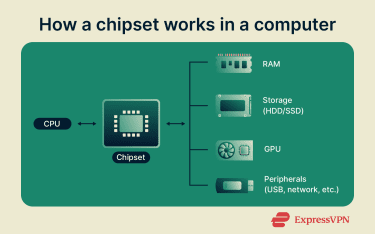
Why is a chipset important?
A chipset manages traffic between components, so it affects how quickly and efficiently RAM, storage drives (including SSDs), and other parts operate, influencing overall system performance and power usage. Some chipsets also provide integrated graphics (built-in graphics processors that handle basic display tasks without needing a separate graphics card).
Additionally, a chipset determines which CPUs, graphics cards (GPUs), and other devices are compatible with a system, while setting limits on features such as the number of USB ports, Wi-Fi support, expansion options, and performance tuning, such as overclocking.
Where are chipsets used?
Chipsets are found in almost all modern electronic devices, including desktops, laptops, smartphones, tablets, Internet of Things (IoT) devices, gaming consoles, routers, and smart TVs. All of these devices contain multiple components that need to communicate, and the chipset manages those interactions.
Further reading
FAQ
What’s the difference between a chipset and a CPU?
A chipset and CPU have very different functions. The CPU is the system's brain. It handles the actual processing of instructions and computations. The chipset organizes and directs how the CPU interacts with other components, like memory, storage, and peripherals, providing the framework that allows the whole system to function together.
Can I upgrade my chipset?
No, a chipset is built into the motherboard and cannot be upgraded separately. Changing the chipset requires replacing the entire motherboard.
What features depend on the chipset?
Chipsets are very important. They determine overall system performance, compatibility with CPUs and GPUs, the number and type of USB ports, storage support, Wi-Fi capabilities, and features such as overclocking. They also set the limits on which devices can be used and how they interact.
Do smartphones have chipsets?
Yes, smartphones include chipsets that manage communication between the CPU, memory, storage, and other components. They also control features like Wi-Fi, Bluetooth, cameras, and cellular connectivity. By coordinating all components, the chipset impacts the device’s overall performance and power efficiency.